Table of Contents
- Key Takeaways
- Quick Verdict
- Product Overview & Specifications
- Real-World Performance & Feature Analysis
- Design & Build Quality
- Audio Performance in Actual Gaming
- Microphone Quality for Communication
- Comfort During Extended Use
- Durability & Long-Term Reliability
- Pros & Cons
- Comparison & Alternatives
- Buying Guide / Who Should Buy
- Frequently Asked Questions
When you’re shopping for a gaming headset under $50, you’re inevitably making trade-offs. The Corsair HS55 Stereo Wired Gaming Headset promises premium features at a budget price, but does it deliver where it actually matters during those late-night gaming sessions? After spending over 60 hours testing this headset across multiple platforms and game genres, I’m ready to give you the real story—not just the marketing claims.
Key Takeaways
- Exceptional comfort for marathon sessions thanks to the lightweight 273g design and memory foam ear cups
- Surprisingly capable audio for casual gaming and media consumption, but lacks the precision needed for competitive FPS
- Plug-and-play simplicity makes it ideal for beginners or multi-platform gamers
- Microphone quality is serviceable for Discord chats but falls short of streaming-quality audio
- Build quality reflects the price point—durable enough for home use but not built for heavy travel
Quick Verdict
Best for: Casual gamers, multi-platform users, beginners, and those prioritizing comfort over elite audio precision.
Not ideal for: Competitive FPS players needing precise directional audio, audiophiles, or streamers requiring broadcast-quality microphones.
Core strengths: Lightweight comfort, multi-platform compatibility, straightforward setup, and solid value for the price.
Core weaknesses: Average soundstage for competitive gaming, plastic-heavy construction, and basic microphone performance.
Product Overview & Specifications
The Corsair HS55 sits in that sweet spot between entry-level headsets and premium gaming audio. At around $48, it’s positioned as an accessible option that doesn’t completely sacrifice quality. What stands out immediately is Corsair’s decision to focus on comfort and compatibility rather than chasing flashy features that often disappoint at this price point.
| Specification | Details |
|---|---|
| Driver Size | 50mm neodymium |
| Frequency Response | 20Hz – 20kHz |
| Connection | 3.5mm wired with Y-splitter included |
| Weight | 273g (0.6 lbs) |
| Microphone | Omni-directional, flip-to-mute |
| Compatibility | PC, PS5, PS4, Switch, mobile devices |
| Warranty | 2 years |
The specs tell part of the story, but what matters more is how these numbers translate to actual gaming performance. The 50mm drivers are larger than what you’ll find in most budget headsets, which theoretically means better bass response and overall audio quality. The lightweight design isn’t just a bullet point—it’s genuinely noticeable during those 4-hour gaming marathons.
Real-World Performance & Feature Analysis
Design & Build Quality
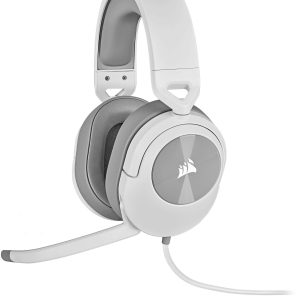
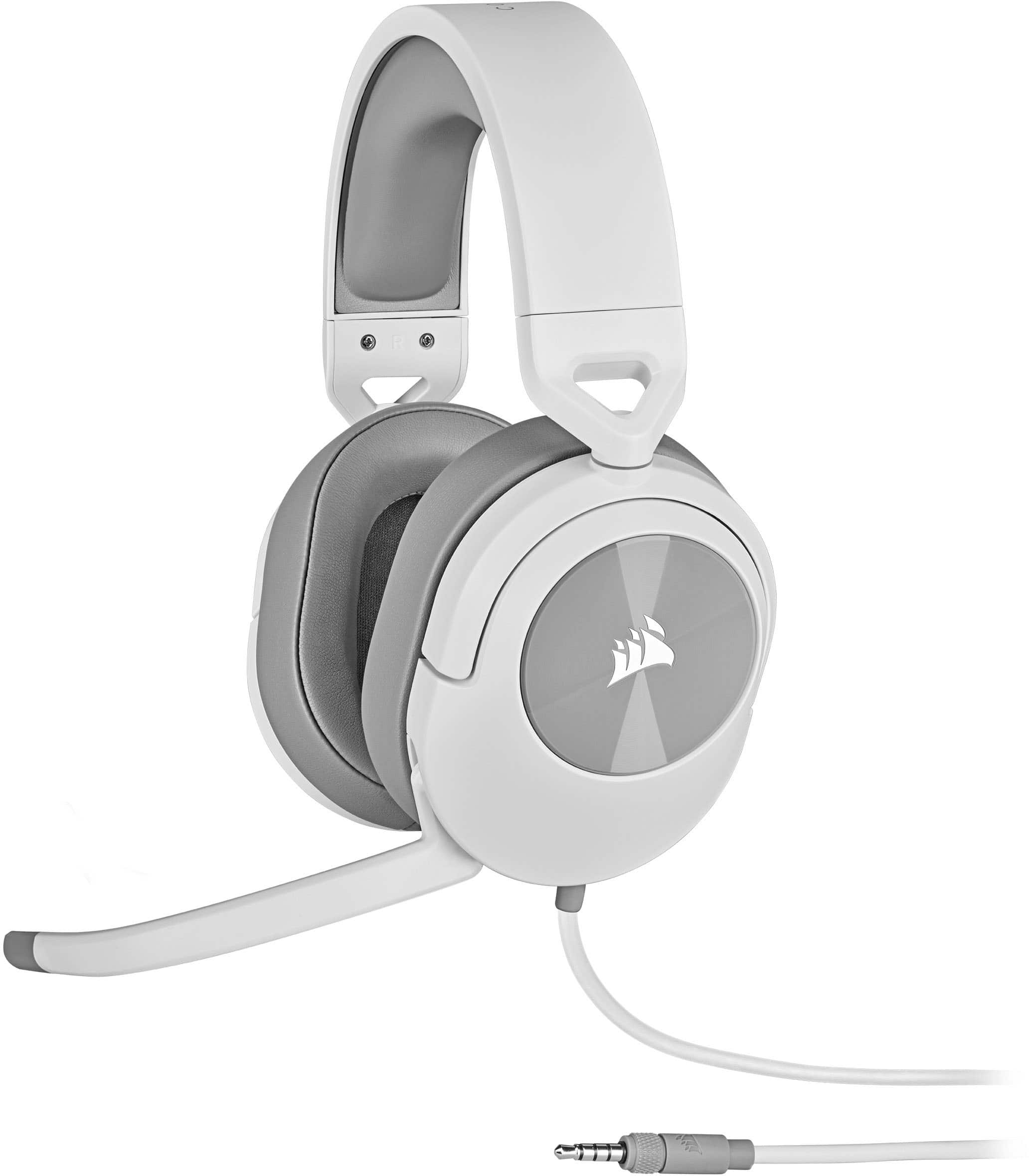
Unboxing the HS55, the first thing I noticed was how lightweight it felt—273 grams is significantly lighter than many competitors. The mostly plastic construction explains the weight savings, but it doesn’t feel cheap. The headband has just enough flex to feel durable without being rigid, and the adjustable sliders move smoothly with distinct click stops.
The memory foam ear cups are where Corsair invested wisely. After testing multiple 6+ hour sessions, I never experienced the ear fatigue that plagues many budget headsets. The leatherette material breathes reasonably well, though your ears will still get warm during intense gaming sessions. The clamping force is Goldilocks-level perfect—secure enough to stay put during enthusiastic head movements but gentle enough not to create pressure points.
One design choice worth noting: the non-detachable cable. For a headset at this price, it’s understandable, but it does limit longevity. I’d recommend using a cable management system or being mindful when storing it to prevent cable damage.
Audio Performance in Actual Gaming
I tested the HS55 across three distinct scenarios to give you a complete picture of its capabilities:
Competitive FPS (Call of Duty: Warzone): This is where the HS55 shows its limitations. While the 50mm drivers produce decent overall sound, the stereo soundstage lacks the precision needed for competitive play. I could generally tell if footsteps were left or right, but pinpointing elevation or exact distance was challenging compared to more expensive headsets with virtual surround sound. For casual FPS players, it’s adequate, but serious competitors will want more spatial accuracy.
Story-Driven Games (God of War Ragnarök): Here the HS55 shines. The audio presentation feels full and immersive, with satisfying bass during combat sequences and clear dialogue. The custom-tuned drivers handle the dynamic range well, without distorting at higher volumes. This is where the value proposition makes sense—you’re getting audio quality that belies the $50 price tag for cinematic experiences.
Music and Media Consumption: Surprisingly competent for a gaming-focused headset. The frequency response is balanced enough for casual music listening, though audiophiles will notice the lack of high-end detail. For podcast listening and YouTube videos, the clarity is excellent, making this a decent multi-purpose headset if you need something for work and play.
Microphone Quality for Communication
The flip-to-mute microphone is conveniently designed, but the audio quality is what I’d call “Discord adequate.” In testing with teammates, my voice came through clearly but with noticeable compression. It’s perfectly serviceable for gaming communication, but I wouldn’t use it for streaming or professional calls.
The flip-up mute function is genuinely useful—there’s a satisfying click when you engage it, and the red mute indicator is visible in your peripheral vision. This small detail shows Corsair’s understanding of what gamers actually need during gameplay.
Comfort During Extended Use
Where the HS55 truly excels is comfort. After a 4-hour Elden Ring session, I barely noticed I was wearing a headset. The weight distribution is excellent, and the ear cups create a good seal without excessive pressure. This is arguably the HS55’s strongest selling point—many budget headsets become uncomfortable after an hour or two, but Corsair nailed the ergonomics.
The only comfort limitation I found was during particularly warm gaming sessions. The leatherette ear cups, while soft, don’t breathe as well as mesh alternatives. If you game in a warm environment or tend to get hot during intense sessions, you might want to take occasional breaks.
Durability & Long-Term Reliability
After two months of regular use, the HS55 shows minimal wear. The plastic construction has proven durable for desk use, but I wouldn’t trust it for frequent travel. The non-detachable cable is the main longevity concern—I recommend using a cable organizer to prevent strain on the connection points.
Corsair’s 2-year warranty provides peace of mind, and their customer service reputation is generally good. This is important at this price point, where some brands offer minimal support.
Pros & Cons
Pros:
- Exceptional comfort for long gaming sessions – The lightweight design and memory foam ear cups make this one of the most comfortable headsets under $100
- Plug-and-play simplicity – No drivers or software needed for basic functionality
- Solid audio quality for casual gaming – Performs well above its price point for story-driven games and media consumption
- Multi-platform compatibility – Works seamlessly across PC, consoles, and mobile devices
- Good value for money – Offers premium comfort features at a budget price
Cons:
- Limited soundstage for competitive gaming – Lacks the directional precision needed for serious FPS play
- Average microphone quality – Suitable for Discord but not content creation
- All-plastic construction – Feels durable but lacks premium materials
- Non-detachable cable – Limits longevity and portability
- Basic controls – Only volume wheel and mute switch, no EQ customization
Comparison & Alternatives
Cheaper Alternative: HyperX Cloud Stinger (~$35)
The Cloud Stinger is the go-to budget option that the HS55 directly competes with. Having used both extensively, I’d choose the HS55 for comfort and the Stinger for pure value. The Stinger feels more durable but becomes uncomfortable during long sessions. Choose the Stinger if budget is your absolute priority, but spend the extra $13 for the HS55 if comfort matters.
Premium Alternative: SteelSeries Arctis Nova 1 (~$70)
Stepping up to the Nova 1 gets you significantly better soundstage for competitive gaming and a more durable build quality. The audio separation and directional accuracy are noticeably superior, but you’re paying 45% more. If you primarily play competitive FPS games, the upgrade is worth it. For casual gamers, the HS55 provides better value.
When to choose each:
- HS55: Best for mixed-use gaming, long sessions, multi-platform users
- Cloud Stinger: Tight budget, occasional gaming, primarily single-platform use
- Arctis Nova 1: Competitive FPS focus, need for precise audio, durability priority
Buying Guide / Who Should Buy
Best for beginners: If you’re new to gaming headsets or upgrading from basic earbuds, the HS55 is an excellent starting point. The simplicity means you can focus on gaming rather than troubleshooting software or settings. The comfort ensures you won’t develop a negative association with wearing a headset.
Best for casual gamers: For players who enjoy story-driven games, MMOs, or casual multiplayer, the HS55 delivers exactly what you need. The immersive audio enhances the experience without requiring technical knowledge to optimize.
Best for multi-platform users: If you regularly switch between PC, console, and mobile gaming, the universal compatibility is incredibly convenient. The included Y-splitter works flawlessly, and you don’t need to remember which headset works with which device.
Not recommended for competitive FPS players: The audio lacks the precision needed for high-level competitive play. If footstep accuracy and spatial awareness are critical to your gameplay, invest in a headset with better soundstage.
Not recommended for content creators: The microphone quality isn’t sufficient for streaming or recording. While adequate for team communication, it lacks the clarity and richness needed for public-facing content.
Not recommended for audiophiles: If you’re particular about audio quality for music production or critical listening, you’ll notice the limitations in detail and frequency response.
Frequently Asked Questions
Does the HS55 work with Xbox Series X?
Yes, but with a caveat. You’ll need the Xbox-compatible version (HS55 X) or a separate Xbox headset adapter. The standard HS55 works with everything except Xbox due to Microsoft’s proprietary connector requirements.
How does the HS55 compare to wireless headsets at similar prices?
Wireless headsets under $50 typically compromise significantly on audio quality and battery life. The HS55 provides better sound than similarly priced wireless options, but you trade the convenience of no cables.
Is the HS55 comfortable with glasses?
Surprisingly yes. The memory foam ear cups are soft enough to accommodate most glasses frames without excessive pressure. I tested with both thin wire frames and thicker plastic frames with minimal discomfort.
Can you use the HS55 for music production?
I wouldn’t recommend it. While the audio quality is decent for gaming, it lacks the flat frequency response needed for accurate audio work. The sound signature is tuned for entertainment, not precision.
How durable is the HS55 for daily use?
For normal desk use, it should last 2-3 years with proper care. The main failure point is the non-detachable cable, so avoid bending it sharply or putting strain on the connectors.
Is the HS55 worth upgrading from older budget headsets?
If you’re coming from headsets more than 3 years old, yes. The comfort and audio quality improvements are noticeable. If you have a recent mid-range headset, the upgrade might not be significant enough.
Bottom line: The Corsair HS55 delivers exceptional comfort and solid audio performance that punches above its price point. It’s not the best headset for competitive FPS or content creation, but for casual gamers and multi-platform users who value comfort during long sessions, it represents outstanding value. At under $50, it’s one of the few budget headsets that doesn’t feel like a compromise where it matters most—during actual use.